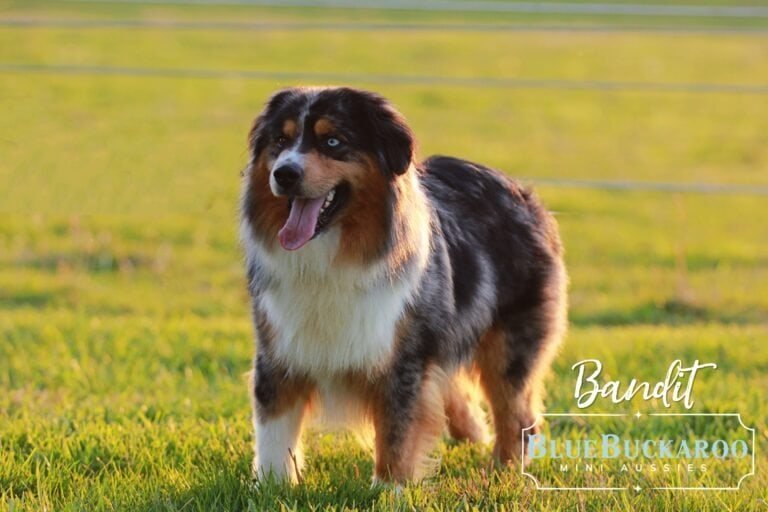
Mini Aussie Full Grown: Size, Weight, and What to Expect
“How big do Mini Aussies get?” is one of the most searched questions about the breed — and one of the most inconsistently answered. The honest answer depends on whether you’re talking about a toy, a mini, the pairing behind the litter, and how you define “fully grown.”
Size matters, but it is not the whole story.
A well-bred Mini Aussie should look like a scaled-down Australian Shepherd — not fragile, not fine-boned, and not bred to an unhealthy extreme. The right size depends on your home, activity level, travel habits, and what kind of dog feels manageable in your real life.
Mini Aussie Size at a Glance
The term “Mini Aussie” covers a range of sizes depending on the breeding program. There is no single universal standard, which is part of why searches for “mini aussie full grown” return such a wide variety of answers. At Blue Buckaroo we produce three size categories — toy, standard mini, and larger mini — and the numbers below reflect what we actually see in our program.
Toy Aussie
Mini Aussie
Larger Mini
In our program the difference between males and females is there but not dramatic. Males tend to run a pound or two heavier and occasionally slightly taller, but you won’t notice a big difference the way you might in larger breeds. Both sexes fall within the same general range for each size category.
Mini Aussie Growth Timeline
Mini Aussies grow quickly in the first six months, then slow down considerably. Most reach their full physical size around 12 months. Mental maturity takes longer — expect 18 months to 2 years before your dog is fully settled — but the scale won’t change much after their first birthday.
Puppy comes home
Toy puppies typically weigh 2–4 lbs. Standard minis run 3–6 lbs. They look tiny and feel delicate but aren’t — they’re just proportionally small at this stage.
Rapid growth phase
Weight roughly doubles from 8 weeks to 12 weeks. Legs start looking long relative to the body — totally normal. Appetite increases noticeably.
Approaching adult height
Most Mini Aussies are close to their full height by 6 months but still have filling out to do. They’ll look lean and rangy at this stage — that’s normal and not a nutrition concern.
Filling out
Growth is slowing significantly. Your dog is adding muscle and body condition rather than height. Coat is starting to come in fully. Starting to look like an adult dog.
Fully grown physically
Weight and height are essentially at adult levels. Minor filling out may continue through 18 months, but the scale won’t move much. Full coat is typically in by now.
Mini Aussie vs Standard Aussie — Size Comparison
If you’re wondering how a Mini Aussie compares to the full-size Australian Shepherd, here’s the practical breakdown. Same breed character, intelligence, and energy — just in a significantly smaller frame.
| Size | Weight Range | Height Range | Best For |
|---|---|---|---|
| Toy Aussie | 13–15 lbs | 13–14 inches | Smaller homes, travel, apartments with exercise access |
| Mini Aussie | 20–30 lbs | 14–16 inches | Most family homes, active owners, farm and ranch life |
| Larger Mini | 30–40 lbs | 16–18 inches | Active families, larger properties, those who want more dog |
| Standard Aussie | 40–65 lbs | 18–23 inches | Working farms, very active households, experienced owners |
What Affects Final Size
The most common question from families on our reservation list is some version of “how big will my puppy get?” The honest answer is that we can give you a range based on the pairing, but we can’t give you an exact number. Here’s what actually influences final size:
The Parents
Parent size is the single strongest predictor. If both parents are on the smaller end of the mini range, expect puppies to land there too. If one parent runs larger, expect some puppies to follow. We know the size history of our dogs and their lines going back multiple generations, which is why we can give reliable size ranges for each litter.
Which Puppy in the Litter
Litter variation is real. In a litter of six puppies from the same parents, the range from smallest to largest can be 5–8 lbs at maturity. The runt doesn’t always stay the runt, and the biggest puppy at 8 weeks isn’t always the biggest adult. If size is a priority for your family, let us know — we factor that into puppy matching.
Nutrition
A dog fed well-balanced nutrition appropriate for their age will grow to their genetic potential. Overfeeding doesn’t make them bigger — it makes them heavier, which puts stress on joints in a growing dog. Underfeeding can stunt development. Feed to a healthy body condition, not to a number on the bag.
Spay and Neuter Timing
Dogs spayed or neutered before growth plates close — typically before 12 months — often grow slightly taller than intact dogs because the sex hormones that signal growth plates to close are removed. The difference is usually minor in small breeds but worth knowing if you’re planning early altering.
You’ll sometimes see these terms used to market very small dogs. There is no official teacup or micro size category in the Aussie world — these are marketing terms, not breed designations. Dogs advertised this way are often either the runts of litters or the product of repeated extreme-size selection that can compromise structure and health. Our toy-sized dogs at 13–15 lbs are bred from standard lines selected carefully smaller — not runts, not crossed with other breeds, not bred to an extreme.
What Full Grown Looks Like in Our Program
We’ve been producing Mini and Toy Aussies from standard Australian Shepherd lines for over 18 years. Our dogs are bred for correct Aussie type at every size — meaning good bone, proper structure, and true Aussie proportions regardless of whether a dog weighs 14 lbs or 38 lbs.
A well-bred Mini Aussie at full size should look like a scaled-down Australian Shepherd — not a fragile, fine-boned dog that happens to have Aussie coloring. Correct bone, a solid topline, good angulation, and a weather-resistant double coat. That’s what we select for at every size level in our program.
If you’ve seen photos of our adult dogs and want to know what size range a particular pairing tends to produce, just ask. We know our lines and we’re happy to give you an honest answer based on what we’ve actually seen — not a guess.
Size is one factor in choosing the right dog. Temperament, structure, and the program behind the puppy matter more. A 14 lb dog and a 35 lb dog from Blue Buckaroo will both be fully, genuinely Australian Shepherds — just in different packages.
Mini Aussie Full Grown Size Questions
How big do Mini Aussies get?
It depends on the size category and the specific pairing. Toy Aussies typically reach 13–15 lbs. Standard minis run 20–30 lbs. Larger minis land at 30–40 lbs. The best predictor is parent size — ask your breeder what the parents weigh and what that pairing has historically produced.
When are Mini Aussies fully grown?
Most Mini Aussies reach their full physical size around 12 months. They’ll do minor filling out through 18 months, but the weight and height are essentially set by their first birthday. Mental maturity takes longer — expect 18 months to 2 years.
Are male Mini Aussies bigger than females?
Slightly, but not dramatically in the mini size range. Males tend to run a pound or two heavier and occasionally a touch taller. Both sexes fall within the same general size range for their category.
How big is a Mini Aussie compared to a standard Australian Shepherd?
A standard Australian Shepherd typically weighs 40–65 lbs and stands 18–23 inches. A Mini Aussie at 20–40 lbs and 14–18 inches is roughly half the weight. A Toy Aussie at 13–15 lbs is even more compact.
Can you predict how big a puppy will get?
With reasonable accuracy, yes — but not to the pound. Parent size, line history, and where the puppy falls in the litter all factor in. A good breeder who knows their lines can give you a reliable range. Anyone who gives you an exact adult weight at 8 weeks is guessing.
What is a teacup or micro Aussie?
These are marketing terms, not official size categories. They typically refer to very small dogs produced by breeding runts together or through other methods that can compromise structure and health. There is no breed standard or registry that recognizes “teacup” or “micro” as official designations.
Helpful Blue Buckaroo Resources
Want to know what size a specific litter is likely to produce?
We know our lines and we are happy to talk through expected size ranges honestly. Size matters, but the best puppy match also considers temperament, structure, family rhythm, and long-term fit.
About the Author
Nicole has been breeding Mini Australian Shepherds for over 18 years at Blue Buckaroo Aussies in Middle Tennessee. With a bachelor’s degree in agriculture and a focus in animal science, she breeds for correct structure, balanced temperament, and resilience — producing Mini Aussies that are as healthy as they are beautiful. She places puppies with families across the United States.
Follow the Daily Adventures of Our Blue Buckaroo Puppies
See puppy videos, training moments, behind-the-scenes updates, and everyday life with our Mini Aussies.