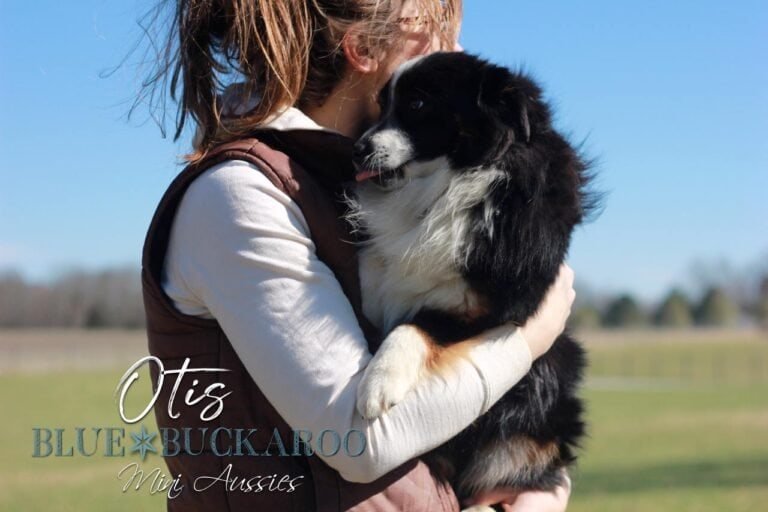
Should Young Families Get a Mini Aussie?
Mini Aussies can be extraordinary family dogs. But they are not low-effort dogs, and some seasons of family life are simply too stretched for what this breed needs.
The dog is not the problem. The fit, structure, timing, and capacity are.
A Mini Aussie in the right family is one of the most rewarding dogs on earth. A Mini Aussie placed into an already-overloaded household can become overwhelming fast. This guide is here to help families make the decision with clear eyes.
If you’ve landed on this page, there’s a good chance you’re scrolling through Instagram photos of fluffy merle puppies with heterochromia eyes, already imagining one curled up with your kids. I get it. I’ve been breeding Mini Australian Shepherds for over 18 years, and they are genuinely extraordinary dogs.
But I’d be doing you a disservice — and the dog a disservice — if I didn’t tell you the full truth first. An Aussie is not a low-effort family dog. And for some young families, the timing is simply not right.
This isn’t about whether you’re a good person or a good parent. It’s about fit, capacity, and timing. Let’s talk through it honestly.
“The dog is never the problem. The structure, leadership, expectations, and fit are.”
An Aussie Is Like Adding Another Toddler
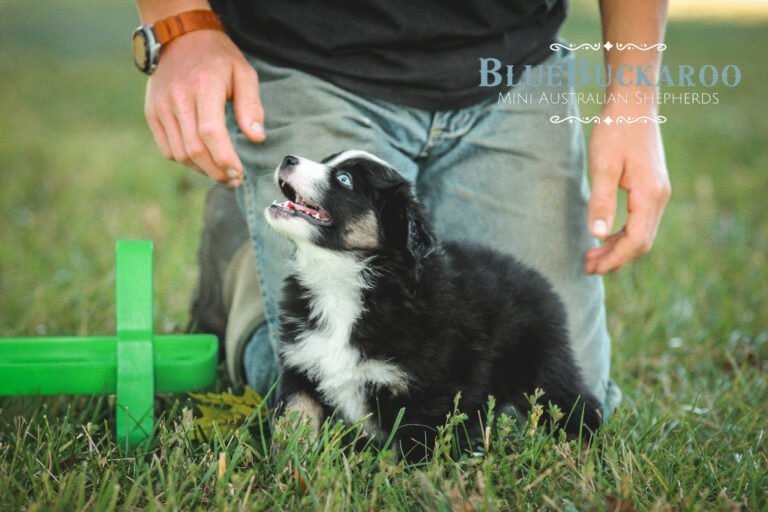
That might sound dramatic, but stick with me. Australian Shepherds — even the Mini variety — were bred to work. All day. Every day. They were engineered to be the most reliable, tireless, driven partner a rancher could have. That instinct doesn’t disappear when they live in a suburban house with a three-year-old.
What does that look like in real life? It looks like a dog who needs 1–2 hours of genuine physical and mental exercise every single day. Not a walk around the block. Not time in the backyard. A job. A run. Structured training. Fetch with purpose. A dog who, without that outlet, will find their own entertainment — and it will never be furniture-friendly.
Now consider what life looks like with young children. You’re sleep-deprived. Your schedule is unpredictable. Your emotional bandwidth is stretched. The idea of carving out 90 minutes of structured dog time every day is not just optimistic — for many families, it’s simply not realistic.
Your Kids Look Like Livestock to an Aussie
I say this with love, but it’s true. Herding is a deeply ingrained genetic drive in Australian Shepherds. It’s not aggression — it’s instinct. When small children run, squeal, and move unpredictably, an Aussie’s brain registers that as something that needs to be managed.
This can manifest as nipping at heels, circling children, or cutting them off mid-run. In a well-trained Aussie with a calm, structured household, this is manageable. In an under-stimulated dog in a chaotic environment with small kids? It becomes a daily problem.
Training absolutely helps. But you cannot train the herding drive out of this breed — you can only redirect and manage it. That requires consistent, knowledgeable handling from day one.
The herding nip is not malicious. Your Aussie is doing what generations of selective breeding have told them to do. The problem isn’t the dog — it’s placing a herding dog in a situation where they’re under-exercised, understimulated, and surrounded by unpredictable small humans with no structure to manage the behavior.
They’re Too Smart for a Distracted Household
Mini Aussies consistently rank among the most intelligent dog breeds in the world. That’s part of their appeal. It’s also part of the challenge.
A smart dog needs mental stimulation just as much as physical exercise. Without it, they don’t just get bored — they problem-solve. They figure out how to open gates. They invent games that involve your couch cushions. They develop anxiety behaviors. They can become reactive, destructive, or obsessive.
In a household where the adults are already stretched thin managing young children, providing the structured mental engagement an Aussie needs is genuinely difficult. Puzzle feeders and training sessions don’t happen on their own.
“Aussies were born to solve problems. Give them a job or they’ll find one. And it won’t be a job you assigned.”
Training Requires Consistency You May Not Have
This is not a breed you can wing. Aussies need clear leadership, consistent rules, and structured training — especially in the first year. Not five-minute sessions when you happen to have time. Daily, intentional work.
The first year with an Aussie puppy is demanding under ideal circumstances. Add a newborn, a toddler, school runs, and the general chaos of young family life, and something will give. Usually it’s the dog’s training. And once you fall behind with an Aussie, catching up is significantly harder.
- You’re currently in the newborn stage or expecting.
- Your household doesn’t have a consistent daily schedule.
- You’ve never trained a high-drive dog before.
- You’re hoping the dog will “calm down” on its own after a year.
- You don’t have a clear plan for 2 hours of daily exercise.
- You’re getting a dog primarily for the children’s benefit.
So When Does It Work?
Here’s where I want to be clear: I am not saying young families cannot have Aussies. Some of my absolute favourite placements have been with active young families who were genuinely prepared. An Aussie with the right family is a spectacular thing.
These dogs are loyal to their core. They are deeply bonded to their people. They are playful, loving, hilarious, and incredibly rewarding. With the right structure in place, they are wonderful with children — patient, protective, and endlessly entertaining.
The question is never “is this a good dog?” The question is always “is this the right dog for our life right now?”
It Can Work If…
- You have an active lifestyle and genuinely enjoy daily exercise.
- Your children are school-age, ideally 6+, and understand dog boundaries.
- One parent works from home or has a flexible schedule.
- You’ve owned a high-drive dog before or done serious research.
- You have time and commitment for consistent daily training.
- You have a fenced property and space to run.
- The whole family is on board — not just the kids.
- You understand this is a 15-year commitment.
Wait If…
- You have children under 4 still in the high-energy, unpredictable stage.
- You’re in the newborn phase or expecting.
- Both parents work full-time with no dog care plan.
- You’re hoping the dog will be low maintenance after puppyhood.
- You’ve never had a dog before.
- Your household is already operating at full capacity.
- You’re getting the dog to teach kids responsibility.
- The timing feels rushed or impulsive.
Love is not the limiting factor. Capacity is.
Most families who struggle with a high-drive puppy do not fail because they lacked love. They struggle because the timing, energy, structure, and daily bandwidth were not there yet.
Under 4
Usually better to wait, especially if your home is already loud, unpredictable, or stretched thin.
Ages 4–6
Possible with serious prep, strong adult leadership, and a realistic dog-care plan.
Ages 6+
Often a great match for active families who enjoy training, outdoor time, and structure.
Capacity vs. Love
This is the most important question I ask every family who reaches out to me. Not “do you love dogs?” — of course you do. Not “are you a responsible person?” — I’m sure you are.
The question is: Do you have the capacity right now?
Capacity means time. It means energy. It means consistency. It means emotional bandwidth on top of an already full life. Love is never the limiting factor with the families who reach out to me. Capacity almost always is.
I’ve had families come back to me two years after we first spoke, after their youngest started school, after their life settled into more of a rhythm. And those placements have been some of the best ones. The dog got what it needed. The family was ready. Everyone thrived.
- Can I commit to 1–2 hours of structured exercise every single day — including bad weather days, sick days, and school holiday chaos?
- Do I have a real training plan for year one, not just good intentions?
- Am I prepared for a dog that will demand more from me than any dog I’ve had before?
- Am I getting this dog because our family is genuinely ready, or because my children really want one?
- If the puppy phase is significantly harder than I expected, do I have the support system to get through it?
The Honest Verdict
Young families can absolutely have Mini Aussies. But I want every family who brings one of my puppies home to succeed — and for the dog to have the life they deserve. That means being honest with you even when it’s not what you want to hear.
If your gut is telling you the timing isn’t quite right — trust it. A good breeder would rather lose a sale than place a puppy in a situation where it won’t thrive.
If you’re reading this and thinking “that’s us — we’re ready” — wonderful. Reach out. Let’s talk through your situation, your lifestyle, your family. I’ve been doing this for 18 years and I love nothing more than making the right match.
The right dog at the right time is one of the greatest joys a family can experience. The wrong dog at the wrong time is hard on everyone — including the dog.
- Health-tested parents — full genetic panel.
- Early neurological stimulation and structured socialization from birth.
- Litter box training started before they leave us.
- Full gut health protocol — Full Bucket, Dogzymes, and Olewo Carrots to support the transition.
- Lifetime breeder support — we’re here for the life of your dog, not just pickup day.
- ASDR registration.
Mini Aussies and Young Families: Common Questions
Are Mini Aussies good with kids?
They can be excellent with children when the household has structure, boundaries, and enough time for daily exercise and training. They are not a “hands-off” family dog.
Are Mini Aussies good with toddlers?
They can be challenging with toddlers because toddlers run, squeal, fall, grab, and move unpredictably. That can trigger herding behaviors like circling, chasing, and nipping.
What age kids are best for a Mini Aussie?
Many families do best when children are school-age, around 6 or older, because the kids can understand boundaries and the adults usually have more consistent routines.
How much exercise does a Mini Aussie need?
Most Mini Aussies need 1–2 hours of real physical and mental exercise daily. Backyard time alone does not count as enough for this breed.
Can a Mini Aussie be a first dog?
Sometimes, but only for families willing to study the breed, commit to training, and build a real daily structure. They are not the easiest first dog for a busy young family.
Should we wait until our kids are older?
If your home is already stretched thin, waiting can be the smartest decision. The right dog at the right time is far better than the right dog at the wrong time.
Helpful Blue Buckaroo Resources
Choose the right dog at the right time.
If your family has the time, structure, and daily capacity for a Mini Aussie, we would love to help you think through fit. If the timing is not right yet, that is not failure. That is wisdom.
Continue Your Mini Aussie Research
Still Deciding If A Mini Aussie Is Right For You?
These guides will help you understand the breed, the lifestyle, and what kind of home helps a Mini Aussie thrive.
Mini Aussie Breed Guide
Learn the temperament, energy level, instincts, and traits that make this breed so special.
Apartment Living
Can a Mini Aussie live happily in an apartment? Yes, with the right structure.
Working Full Time
How to raise a Mini Aussie when you have a real work schedule and a real life.
Male vs Female
A practical look at personality, fit, and what matters more than gender.
Follow the Daily Adventures of Our Blue Buckaroo Puppies
See puppy videos, training moments, behind-the-scenes updates, and everyday life with our Mini Aussies.